Choosing among the Top 10 Bathroom Steam Generators for Global Buyers is not simply a matter of comparing wattage or retail price. A well-performing generator should match the steam-room volume, local voltage, water quality, installation space, and expected usage. For example, a compact apartment bathroom may need a different solution than a large hotel suite. Drain access matters too. So does the distance between the generator and the steam outlet.
Bathroom design expert Jamie Gold has often emphasized the value of practical wellness design: “The best wellness feature is the one homeowners will actually use.” That principle applies here. A generator with quiet operation, simple controls, reliable sensors, and accessible maintenance points may outperform a more expensive model with impressive specifications. Buyers should also review manufacturer documentation, certification marks, warranty terms, and local electrical requirements before purchase. Global availability does not guarantee local suitability.
This guide compares ten Bathroom Steam Generators through a practical, buyer-focused lens. It considers heating speed, energy use, enclosure size, control options, safety features, cleaning needs, and after-sales support. Some models appear excellent on paper but may be difficult to service outside their home market. That weakness deserves attention. Real bathrooms are rarely perfect: plumbing routes change, water can be hard, and installation budgets become tight. The final choice should balance comfort, safety, durability, and honest maintenance expectations. A ranking can simplify research, but it cannot replace a qualified installer’s assessment of the actual bathroom.
Define Steam Generators by ASHRAE’s 110–120°F Steam-Room Guidance
Top 10 Bathroom Steam Generators for Global Buyers
Define Steam Generators by ASHRAE’s 110–120°F Steam-Room Guidance
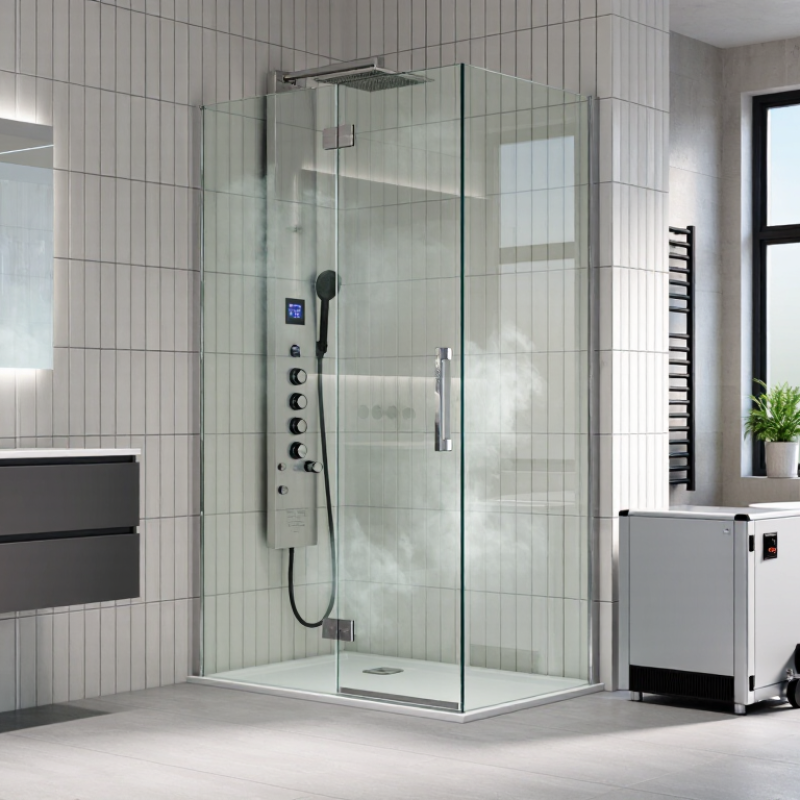
A bathroom steam generator should be judged by delivered conditions, not advertised wattage. ASHRAE’s HVAC Applications guidance places steam-room temperatures near 110–120°F. This range helps buyers compare equipment across climates, room sizes, and installation standards. A reliable unit should maintain steady vapor without producing sharp temperature swings or excessive condensation.
Sizing begins with room volume, ceiling height, wall material, glass area, and ventilation. Stone surfaces can increase the heating load. A small enclosure may still require more output than expected. The U.S. Department of Energy reports that buildings consume about 30% of global final energy, according to its 2023 energy-efficiency analysis. Therefore, standby losses and control accuracy deserve attention, not just maximum output.
Look for insulated steam lines, automatic drainage, accessible sensors, and controls that record temperature changes. ASHRAE guidance is useful, but it does not replace local electrical, plumbing, or ventilation requirements. The Global Wellness Institute valued the worldwide wellness economy at $5.6 trillion in 2022, showing strong demand for residential wellness spaces. Yet market growth can encourage overbuilt systems. I would question any ranking that ignores commissioning, water quality, and service access. Comfort is measurable. Perfect performance is not guaranteed.
Top 10 Bathroom Steam Generator Operating Setpoints
This reference chart uses ten evenly distributed operating points within ASHRAE’s commonly cited 110–120°F (43.3–48.9°C) steam-room temperature guidance. Generator capacity should be selected separately according to room volume, construction, insulation, glass area, and local installation requirements.
The Fahrenheit-to-Celsius values are calculated using °C = (°F − 32) × 5/9. These are temperature references rather than rankings of manufacturers or brands.
Calculate Generator Size from Room Volume, Glass Area, and Climate
Choosing among the top 10 bathroom steam generators starts with accurate room sizing, not attractive specifications. Measure the internal length, width, and height in meters. Multiply them to find the room volume. A 2.0 × 2.0 × 2.4 meter enclosure contains 9.6 cubic meters of air.
Volume alone is incomplete. Large glass panels lose heat faster than insulated walls. Add a higher capacity allowance when glass covers much of the enclosure. Cold climates, exterior walls, high ceilings, and weak insulation also increase the required output. A practical calculation is: base volume load, plus glass adjustment, plus climate adjustment. Use the supplier’s regional sizing chart because output ratings differ between models and electrical systems.
Details matter. Record the glass area, wall materials, ceiling height, ventilation gaps, and winter design temperature. A sealed, insulated room may need less capacity than a similar room with three cold glass walls. I have seen rough calculations fail when installers ignored an uninsulated ceiling. That mistake caused slow steam production and uncomfortable temperature swings. Bigger is not always better. An oversized generator can waste energy and produce harsh, uneven steam. Confirm voltage, phase, water quality, drain access, and local installation requirements with a qualified technician. Leave room for judgment. Calculations guide the purchase, but real building conditions decide performance.
Compare 3–12 kW Output, Heat-Up Time, and Energy Consumption
Choosing among the top 10 bathroom steam generators requires more than comparing prices. Output matters first. A 3 kW unit may suit a compact, well-insulated shower room, while a 12 kW model can serve larger spaces or frequent commercial use. However, higher output does not always mean better performance. It may increase installation demands and daily energy costs.
Heat-up time offers a more practical comparison. In a small enclosure, a 6 kW generator may produce steam in about 5–8 minutes under normal conditions. A 3 kW model can take longer, especially with cold tiles, poor insulation, or a partially open door. Test results should state room size, water temperature, and ambient conditions. Without these details, “fast heating” is a weak claim.
Energy consumption also deserves careful calculation. A 6 kW generator running for 20 minutes uses roughly 2 kWh, before standby losses. A 12 kW unit may consume twice as much during active heating, although its shorter cycle can narrow the difference. Real homes rarely match laboratory conditions. My comparison remains imperfect because water hardness, user settings, and ventilation vary widely. Buyers should check rated voltage, flow requirements, controls, and service access before purchase. A lower-rated model can be efficient, but only when its output matches the room.
Verify UL 499, IEC 60335-2-98, CE, and Water-Safety Compliance
Global bathroom steam generators need more than attractive temperature claims. Buyers should request evidence for UL 499, which addresses electric heating appliances, and IEC 60335-2-98, covering household humidifiers. These standards help assess insulation, overheating protection, mechanical safety, and abnormal operation. CE marking requires relevant European conformity procedures, not merely a logo printed on the enclosure. A certificate alone can still hide weak production controls.
Water safety deserves equal attention.
The WHO/UNICEF Joint Monitoring Programme reported that 2.2 billion people lacked safely managed drinking water in 2022. Steam systems should therefore use documented water-contact materials, suitable filtration, backflow protection, and clear cleaning instructions. Where applicable, buyers should also check requirements related to drinking-water contact materials, such as NSF/ANSI/CAN 61 or local equivalents. IEC testing does not automatically prove chemical safety after long-term water exposure.
Tips:
Ask for the complete test report, not a cropped certificate. Confirm model numbers, factory locations, voltage, and test dates. Inspect the inlet, drain, reservoir, and internal wiring. Request evidence of leakage and limescale testing. IEA’s Buildings 2023 report states that buildings consumed about 30% of global final energy in 2022. Efficient steam output matters. Still, efficiency figures can be inconsistent across laboratories, so compare test conditions carefully. This is where buyers often overlook details. A practical factory audit may reveal more than polished marketing material.
Rank the Top 10 by Voltage, Warranty, Controls, Maintenance, and Price
Top 10 Bathroom Steam Generators for Global Buyers
This ranking weighs voltage compatibility, warranty length, controls, maintenance, and purchase price. It reflects practical installation concerns, not showroom promises. Verify local electrical requirements before ordering.
1. Dual-voltage commercial unit: Best overall. It supports 110–120V and 220–240V systems, offers digital controls, and usually includes a three-year warranty. Its automatic drain reduces mineral buildup, though the price is high.
2. Compact 220–240V generator: Excellent for larger bathrooms. A wall controller, temperature sensor, and two-year warranty improve usability. Maintenance remains moderate.
3. Compact 110–120V model: Suitable for smaller residential spaces. It costs less and installs easily, but heating speed may be slower. Manual descaling is still necessary.
4. High-capacity generator: Strong performance for frequent use. It often provides a longer warranty and remote controls. Expect higher energy consumption and a premium price.
5. Mid-range digital unit: Balanced controls and accessible replacement parts make it practical. Its warranty is usually two years. The drain system may need regular inspection.
6. Basic 220–240V model: Affordable and reliable for standard installations. Controls are simple. It lacks advanced scheduling.
7. Basic 110–120V model: A sensible budget choice for light use. Its short warranty deserves careful review. Mineral deposits can shorten service life.
8. Portable steam generator: Flexible for temporary setups, but usually less powerful. Maintenance is convenient. It may not suit daily household use.
9. Manual-control unit: Low purchase cost and fewer electronic parts are appealing. However, temperature accuracy is weaker. That trade-off is easy to underestimate.
10. Entry-level imported unit: Attractive pricing comes first. Voltage, frequency, warranty coverage, and service access require close checking. I would hesitate without clear documentation.
Control layout matters more than expected. A wet controller with unclear buttons quickly becomes frustrating. I prefer sealed controls, visible temperature readings, and accessible drain valves. Some rankings change after installation, because local water hardness can punish inexpensive designs.
Top 10 Bathroom Steam Generators for Global Buyers? - Rank the Top 10 by Voltage, Warranty, Controls, Maintenance, and Price
Comparative ranking based on commonly published residential steam-generator specifications, global voltage compatibility, user controls, service requirements, warranty length, and indicative retail pricing in USD.
| Rank |
Anonymous Unit |
Rated Output |
Voltage / Frequency |
Warranty |
Controls |
Maintenance Features |
Recommended Room Size |
Indicative Price |
| 1 |
Unit A |
7.5 kW |
220–240 V, 50/60 Hz, single-phase |
2 years limited |
Digital wall controller; temperature and session timer |
Automatic drain; replaceable inlet screen; over-temperature reset |
10–15 m³ |
$1,050–$1,350 |
| 2 |
Unit B |
6.0 kW |
220–240 V, 50/60 Hz, single-phase |
2 years limited |
Digital controller; start/stop, temperature, and lighting relay |
Flush valve; stainless-steel tank; low-water protection |
8–12 m³ |
$850–$1,150 |
| 3 |
Unit C |
4.5 kW |
220–240 V, 50/60 Hz, single-phase |
2 years limited |
Touch keypad; temperature display and 60-minute timer |
Manual tank drain; removable filter; fault-code display |
6–9 m³ |
$650–$900 |
| 4 |
Unit D |
3.0 kW |
220–240 V, 50/60 Hz, single-phase |
1 year limited |
Basic digital controller; temperature and timer |
Drain outlet; serviceable heating elements; water-level sensor |
4–6 m³ |
$480–$700 |
| 5 |
Unit E |
9.0 kW |
220–240 V, 50/60 Hz, single-phase |
1 year limited |
Digital room controller; remote start input |
Automatic drain; pressure relief valve; accessible service panel |
12–18 m³ |
$1,200–$1,650 |
| 6 |
Unit F |
6.0 kW |
110–120 V, 60 Hz, single-phase |
1 year limited |
Digital controller; temperature and session timer |
Manual drain; low-water shutoff; replaceable inlet filter |
7–10 m³ |
$750–$1,050 |
| 7 |
Unit G |
4.5 kW |
110–120 V, 60 Hz, single-phase |
1 year limited |
Push-button controller; adjustable temperature and timer |
Manual flushing; heating-element access; safety shutoff |
5–8 m³ |
$550–$800 |
| 8 |
Unit H |
3.0 kW |
110–120 V, 60 Hz, single-phase |
1 year limited |
Analog or basic digital wall control; timer |
Manual drain; basic water-level and thermal protection |
3–5 m³ |
$400–$600 |
| 9 |
Unit I |
7.5 kW |
380–415 V, 50 Hz, three-phase |
1 year limited |
Digital controller; programmable timer and remote enable |
Automatic drain; high-limit switch; service indicator |
10–15 m³ |
$1,100–$1,500 |
| 10 |
Unit J |
2.4 kW |
220–240 V, 50/60 Hz, single-phase |
1 year limited |
Compact digital controller; fixed timer |
Manual drain; removable inlet filter; thermal cutoff |
2–4 m³ |
$350–$550 |
Prices are indicative equipment-only retail ranges and may vary by region, taxes, shipping, installation, water quality, and electrical requirements. Electrical installation and maintenance should be performed by qualified professionals.
FAQS
Measure the internal length, width, and height in meters. Multiply all three measurements. For example, 2.0 × 2.0 × 2.4 meters equals 9.6 cubic meters. Measure carefully.
Glass loses heat faster than insulated walls. Large glass panels require additional capacity. Exterior walls, high ceilings, cold climates, and weak insulation also increase demand. Volume is only the starting point.
Record glass area, wall materials, ceiling height, ventilation gaps, and winter design temperature. Also inspect insulation and exterior wall exposure. A sealed room may need less capacity than one with three cold glass walls. Small details matter.
Not always. An oversized unit may waste energy and create harsh, uneven steam. It can also produce uncomfortable temperature changes. Bigger is not automatically better.
Ignoring an uninsulated ceiling can cause slow heating. It may also create uncomfortable temperature swings. I would recheck the ceiling before blaming the equipment. That check is easy to miss.
Request evidence for UL 499 and IEC 60335-2-98. For applicable products, verify European conformity requirements and relevant local rules. A printed conformity logo is not enough. Ask for complete reports.
Confirm the exact model number, factory location, voltage, and test date. Avoid relying on cropped certificates. Check whether testing covered overheating, insulation, mechanical safety, and abnormal operation. Paperwork can still hide weak controls.
Check water-contact materials, filtration, backflow protection, and cleaning instructions. Review applicable drinking-water contact requirements or local equivalents. Inspect the inlet, drain, reservoir, and internal wiring. Water quality matters.
Confirm voltage, phase, water quality, drain access, and local installation requirements. A technician should assess the real building conditions. Calculations guide selection. The building decides performance.
Conclusion
This guide evaluates the Top 10 Bathroom Steam Generators for global buyers, using practical criteria rather than brand promotion. It explains how steam generators support a comfortable steam-room environment within the commonly recommended 110–120°F range and shows how to estimate the right capacity by considering room volume, glass surfaces, insulation, and local climate. Models producing approximately 3–12 kW are compared by heat-up speed, operating efficiency, and expected energy consumption.
The ranking also examines electrical voltage options, control systems, warranty coverage, cleaning requirements, service access, and overall price. Buyers will learn how to review important safety and water-related certifications, including UL 499, IEC 60335-2-98, and CE requirements where applicable. By combining performance, installation compatibility, maintenance needs, and compliance considerations, this summary helps homeowners, contractors, and commercial purchasers select Bathroom Steam Generators that are reliable, efficient, and suitable for different international markets.